




The Effect of Tablet Shape on Marking Parameters

When you tune a UV marking process, you rarely optimize for “tablets” in general. You optimize for a specific shape family, size range, edge profile, and coating system. In this explainer, we break down the effect of tablet shapes on marking parameters and what to watch for during validation, scale-up, and change control.
Why Tablet Shape Changes the Marking Window
Marking performance depends on maintaining consistent energy delivery to a predictable surface. Tablet shape influences that consistency in multiple ways.
First, shape changes surface curvature and local angle-of-incidence, which shifts effective spot size and energy density across the mark. Second, shape affects handling stability in the transport path, which impacts registration, placement repeatability, and dwell. Third, shape drives how well machine vision can locate edges, centers, and key features for closed-loop alignment. When you treat shape as a first-class variable, you reduce surprises during tech transfer, and you protect OEE.
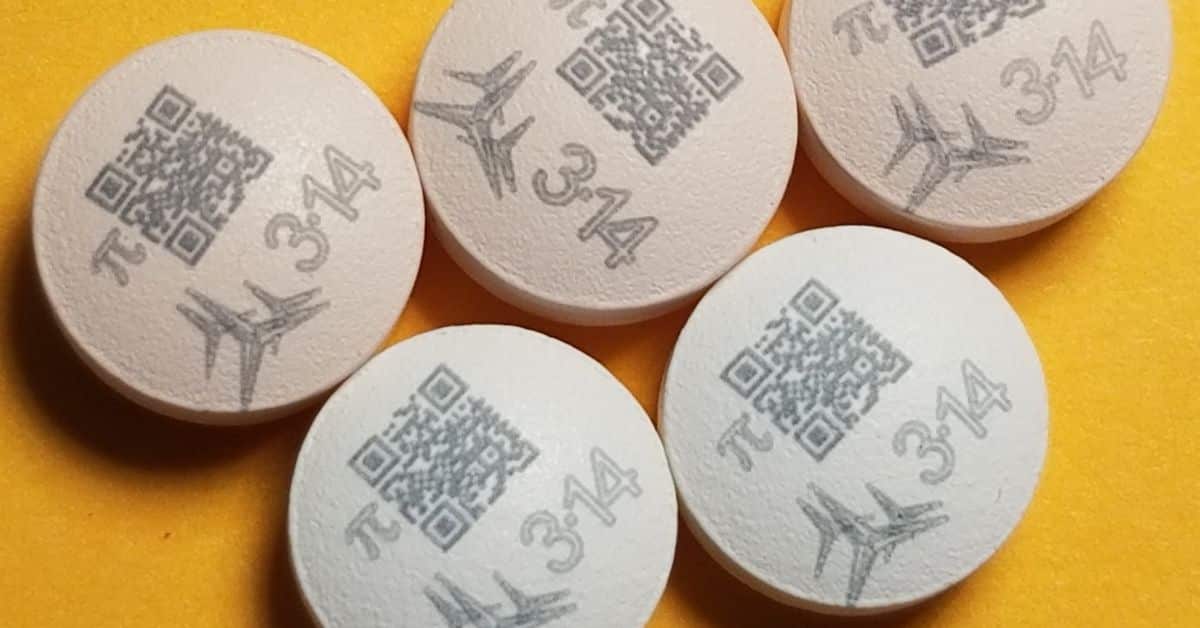
Flat-Faced Round Tablets
Flat, round tablets usually provide the widest process latitude. The face offers a predictable plane, and the perimeter gives strong contrast for centering. That combination helps maintain tight mark placement with moderate conveyor speeds.
Parameter Implications
You typically set focus to the nominal face height and rely on depth-of-focus to cover minor thickness variation. You can typically run faster scan speeds and shorter dwell times because curvature does not force you to “overpay” with energy to maintain legibility at the edges.
If you mark near the perimeter, watch for edge roll-off. The face may look flat, but a small bevel can reduce effective energy density and soften fine features like small text or high-density 2D codes.
Biconvex and Curved Tablets
Curved faces change the distance to the focal plane across the mark field. Even if you focus perfectly at the center, the outer regions may sit slightly out of focus. That can widen the spot, reduce contrast, and drive variability in mark darkness.
Parameter Implications
It’s frequently best to compensate in one of three ways: tighten beam focus control, reduce the mark field size, or slow scanning to increase energy per unit area. In practice, you may end up adjusting pulse repetition frequency, scan speed, and line spacing together to keep the mark legible without overheating the surface.
Curved tablets also increase sensitivity to tablet-to-tablet thickness variation. If your coating thickness varies and you already operate near the edge of depth-of-focus, your mark can drift from crisp to faint with no obvious upstream alarm. It’s also worth noting that you should be wary of your optics setup so that you’re not too close to the edge of the depth-of-focus. Your Rayleigh range (the number of mm the beam waist/focus is maintained) fully envelopes any variation of the pills coating.
Oval, Oblong, and Caplet Shapes
Non-round shapes add an extra requirement: orientation control. If you want a consistent mark location and readable orientation for text or codes, you must control rotation in the transport path or correct for it with vision.
Parameter Implications
If you allow free rotation, you usually can widen the acceptable placement window and simplify art. If you must place marks in a specific zone, you typically rely on machine vision to identify the major axis and trigger the mark at a consistent pose.
This can influence your line speed more than the laser settings. Registration overhead, image processing time, and reject logic can become the bottleneck, not the mark itself.
Scored Tablets and Debossed Geometry
Score lines, logos, and debossed text create micro-topography. That texture changes how energy distributes across the surface and can break up thin strokes, especially on small fonts and dense graphics.
Parameter Implications
You may need to adjust hatch spacing or increase stroke width to prevent the mark from “falling into” a score line. If you mark across a score, you can see contrast differences between the ridge and trough because the beam meets different local angles and heights.
Edge Profiles, Bevels, and Chamfers
Small edge design changes can produce outsized marking effects. A bevel can distort a code if the code extends into a region with a changing slope. A chamfer can create a bright or dark band that confuses vision inspection and shifts your contrast thresholds.
If you need to mark near an edge for layout reasons, you usually get better repeatability by shrinking the mark field and centering it farther from the transition zone. That can let you maintain throughput without pushing power or dwell higher than necessary.
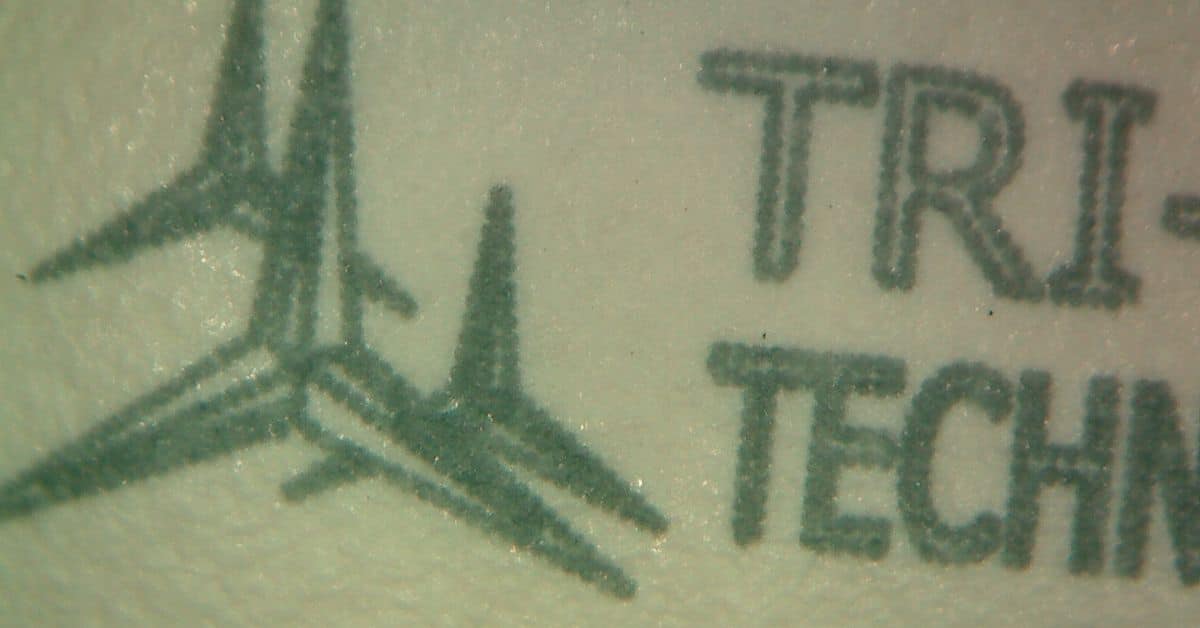
Tablets Marked Through Blister Packaging
Tri-Star Technologies’ pharmaceutical laser marking equipment makes marking tablets or capsules through a clear blister window possible. That workflow adds optical and mechanical variables that interact with tablet shape.
A flat face behind a consistent window thickness behaves more predictably than a highly curved tablet that creates reflections or changing standoff distances. Shape can also influence how the tablet sits in the pocket, which changes the working distance and can shift focus conditions from cavity to cavity. When you validate this approach, include pocket-to-pocket variation and tablet seating variation as part of the study design, not as an afterthought.
How Shape Interacts with Coatings and Formulation
While tablet shape has a significant effect on marking parameters, it’s far from the only factor. Coating type, pigment system, and surface finish can dominate the final settings. For UV processes, the formulation and coating system can influence how the surface changes color or contrast under exposure, while shape controls how evenly you deliver that exposure across the mark. When you see a “shape problem,” you may actually see a combined effect of curvature-driven focus loss and coating-driven sensitivity.
In practice, you manage this by locking your critical-to-quality attributes. You define acceptable ranges for tablet thickness, coating thickness, and surface roughness, then you tune your marking settings to remain robust across those ranges.
Where a Purpose-Built System Helps
A production-ready tablet marking solution combines beam delivery, handling, and inspection so you can maintain repeatability as shapes change. Tri-Star’s tablet and capsule marking systems emphasize non-invasive marking and can support templates that align to specific tablet sizes, shapes, and coatings, which helps teams standardize settings during changeovers and scale-up. If your product portfolio includes multiple shape families, you gain speed by creating a shape-based parameter strategy that links tablet geometry to validated focus conditions, art rules, and inspection thresholds.
Conclusion
Tablet shape influences marking because it changes curvature, stability, and alignment, all of which affect how consistently the system delivers energy to the same place on the surface. Flat, round tablets typically give the broadest process window. Curved and non-round shapes typically force tighter focus control, stronger orientation strategy, and more deliberate art choices.
If you want to reduce validation cycles and protect throughput, treat shape as a primary input during process development. To evaluate shape-specific feasibility and define a robust parameter window, Tri-Star can review your tablet geometries, coatings, and marking requirements and recommend a practical path to validation.