




What Materials Are Suitable for UV Laser Marking?
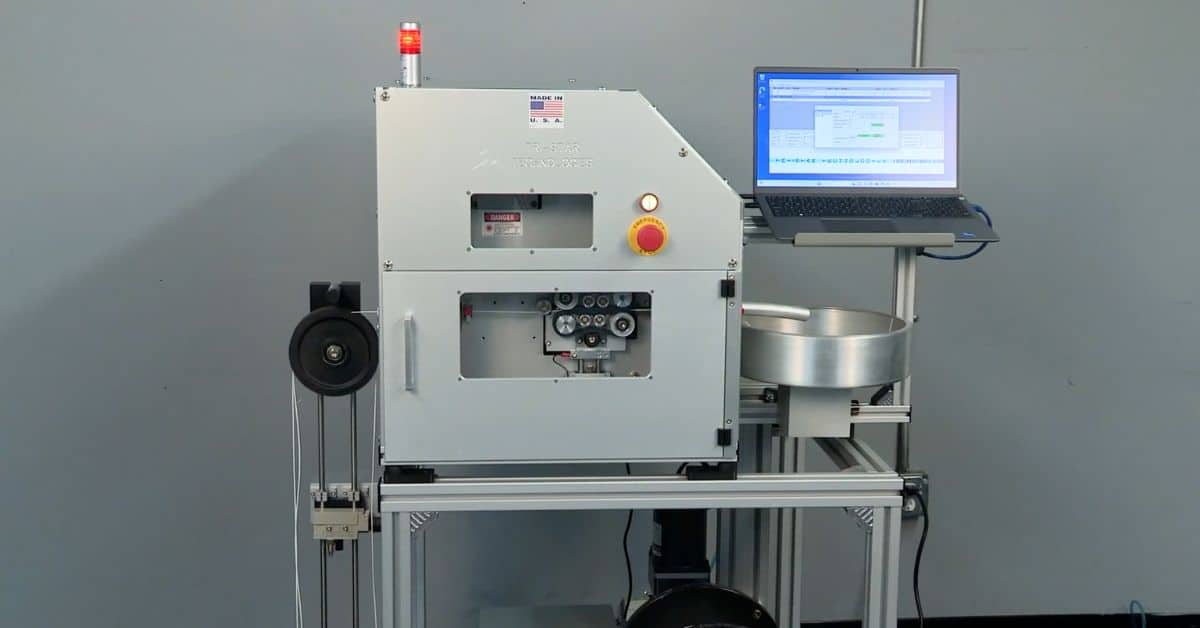
In precision manufacturing, traceability and identification are essential, especially in industries such as aerospace and medical devices, where permanent, legible marks must not compromise material integrity. UV laser marking is the gold standard for non-destructive, high-contrast identification, though not all materials respond equally to UV light.
Understanding which substrates are compatible with this technology is key to optimizing production and making marks that meet industry standards. In this guide, we’ll explain what materials are suitable for UV laser marking, factors that affect material suitability, and more.
Introduction to UV Laser Marking
UV laser marking uses ultraviolet light, typically at 355nm, to create marks on a surface. Unlike infrared lasers, which typically rely on thermal ablation (burning) to create a mark, UV lasers use a photochemical process that is also known as “cold marking” because it introduces minimal heat stress to the material.
Brief Overview of UV Laser Marking Technology
The core mechanism involves the laser beam interacting with the surface material at a molecular level. The high energy of UV photons can break chemical bonds or, more commonly in industrial applications, interact with additives like titanium dioxide (TiO2) within the material. This interaction causes a color change—usually turning white or light-colored surfaces to a high-contrast dark gray or black—without removing material or creating a raised surface.
Advantages Over Traditional Methods
When comparing with traditional methods such as hot stamping or inkjet printing, UV laser marking offers distinct advantages. Hot stamping, which essentially burns the insulation, can compromise the dielectric strength of wire insulation—a major risk in aerospace applications. Inkjet printing, while non-destructive, can fade over time or rub off without proper curing or pre-treatment. UV laser marking, meanwhile, provides:
- Permanence: The mark is integral to the material, making it resistant to solvents, fuels, and abrasion.
- Non-destructive Nature: It does not damage the structural integrity of the wire insulation or device surface.
- High Precision: It enables printing in varying font sizes, intricate graphics, barcodes, and logos.
Importance of Material Selection
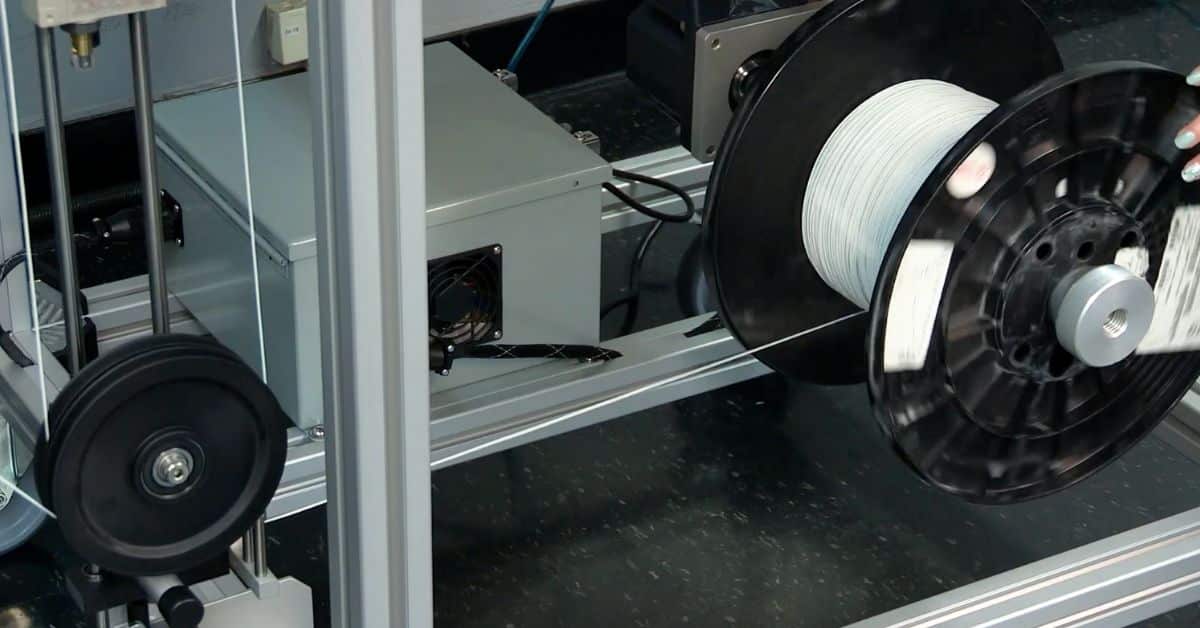
The success of UV laser marking depends heavily on the substrate. While the laser itself is a powerful tool, it requires a material that is receptive to the specific wavelength of UV light. Choosing the right material ensures high-contrast marks that meet legibility specifications like SAE ARP5607 and SAE AS5649.
Appropriate Materials for UV Laser Marking
The versatility of UV lasers allows them to mark a wide array of materials. However, not all materials are suitable for UV laser marking. Below are polymers, plastics, and metals that are appropriate for UV laser marking.
Polymers and Plastics
Plastics are the primary beneficiaries of UV laser “cold marking.” The lack of heat prevents melting, charring, or bubbling, resulting in a smooth finish.
Polyvinyl Chloride (PVC)
PVC is a widely popular thermoplastic polymer. It absorbs UV light exceptionally well. Marking PVC with a UV laser will produce a high-contrast, permanent dark mark. This makes it an excellent candidate for wire insulation and general industrial labeling.
Polyethylene (PE)
Polyethylene is common in packaging and industrial containers. While pure PE can be challenging to mark due to its transparency to certain wavelengths, UV lasers can induce a photochemical reaction, especially when the PE contains specific additives to enhance laser absorption.
Polyurethane (PU)
Many industries value polyurethane for its flexibility and durability. UV lasers create distinct, dark marks on PU without compromising its elasticity. This is particularly useful for medical tubing and flexible cables where the mark must endure bending and flexing.
Polyamide (PA)
Commonly known as Nylon, Polyamide is in everything from automotive parts to cable ties. UV laser marking on Nylon results in high-contrast marks. The process is effective on both glass-filled and standard Nylon grades, making it versatile for engineering components.
Polyethylene Terephthalate (PET)
The electronics components and packaging sectors extensively utilize PET. UV lasers can mark PET with high precision. Because PET is susceptible to heat damage, the “cold” nature of UV lasers prevents the material from warping or becoming brittle during the marking process.
Metals
While UV laser marking is common for marking fragile plastics and polymers, it’s also useful for marking metal. UV lasers have a niche in metal marking that requires a minimal heat affect zone (HAZ).
Stainless Steel
UV lasers can anneal stainless steel, creating a dark oxide layer on the surface without removing metal. This is vital for medical tools where surface smoothness prevents bacterial growth.
Aluminum
UV marking on aluminum can produce crisp, high-contrast marks. It is effective on anodized aluminum, where the laser can bleach the dye or cleanly remove the oxide layer to reveal the base metal.
Titanium
Titanium reacts well to UV wavelengths. Like stainless steel, UV laser can mark it for medical implants and aerospace components where maintaining the material’s structural properties is non-negotiable.
Wire and Cable Marking Materials
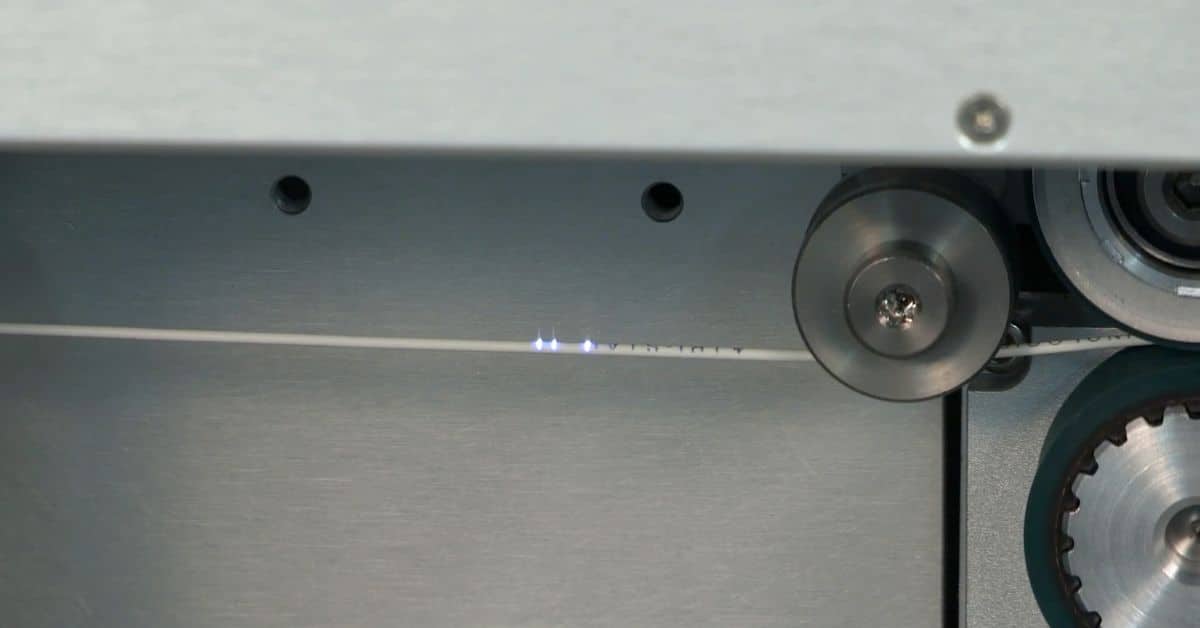
The wire and cable industry, particularly within aerospace, relies heavily on UV wire marking systems for harness identification. The effectiveness of marking wire insulation frequently depends on the presence of Titanium Dioxide (TiO2). This pigment, which makes insulation white or light-colored, strongly absorbs UV radiation.
- ETFE (Ethylene Tetrafluoroethylene): Commonly found in M22759/16 and /32 wires, and yields good to excellent contrast levels.
- PTFE (Polytetrafluoroethylene): Found in M22759/80-92 series wires, pure PTFE is transparent to UV light, but TiO2-doped PTFE tape wrap marks effectively.
- XLETFE (Cross-linked ETFE): This material, common in BMS 13-48 and M27500 specifications, offers some of the best marking contrast available.
Factors Affecting Material Suitability
Simply having a markable material does not guarantee a perfect result. Several variables influence the quality and durability of the mark.
Laser Power and Speed
Pulse duration and energy density define the interaction between the laser and the material. Excessive power can cause overheating, even with a UV laser, potentially damaging the insulation. Conversely, insufficient power may result in a faint or “ghost” mark. Systems like the Tri-Star Technologies’s M100LFGTTA series can balance marking speed (up to 100 ft/min) with the appropriate energy levels to guarantee consistency.
Material Composition and Additives
In wire insulation marking, additives play a critical role. A material that is naturally transparent to UV light will not mark well. Manufacturers frequently must introduce laser-sensitive additives (such as TiO2 or carbon black) at concentrations of two to four percent to enhance absorption. The consistency of this additive distribution throughout the material affects the uniformity of the mark.
Environmental Conditions
The finished product’s operating environment dictates material selection. For example, a UV-marked wire in an aircraft engine bay must withstand high temperatures and potential chemical exposure. The UV mark itself is highly stable—tests have shown that UV marks on TiO2-doped ETFE retain legibility even after thousands of hours of thermal aging and simulated solar exposure.
Improve Your Product Identification Today
Choosing the right material for UV laser marking is a science that combines polymer chemistry with optical physics. When done correctly, it results in a permanent, high-contrast, and non-damaging mark that withstands the rigors of industrial use.
For manufacturers dealing with critical applications, guessing isn’t an option. Tri-Star Technologies specializes in developing state-of-the-art marking systems for strict military and commercial specifications. If you have any questions about UV laser marking, material suitability, or our marking systems, contact Tri-Star Technologies today.