




Laser Wire Marking: Identification in Harsh Environments
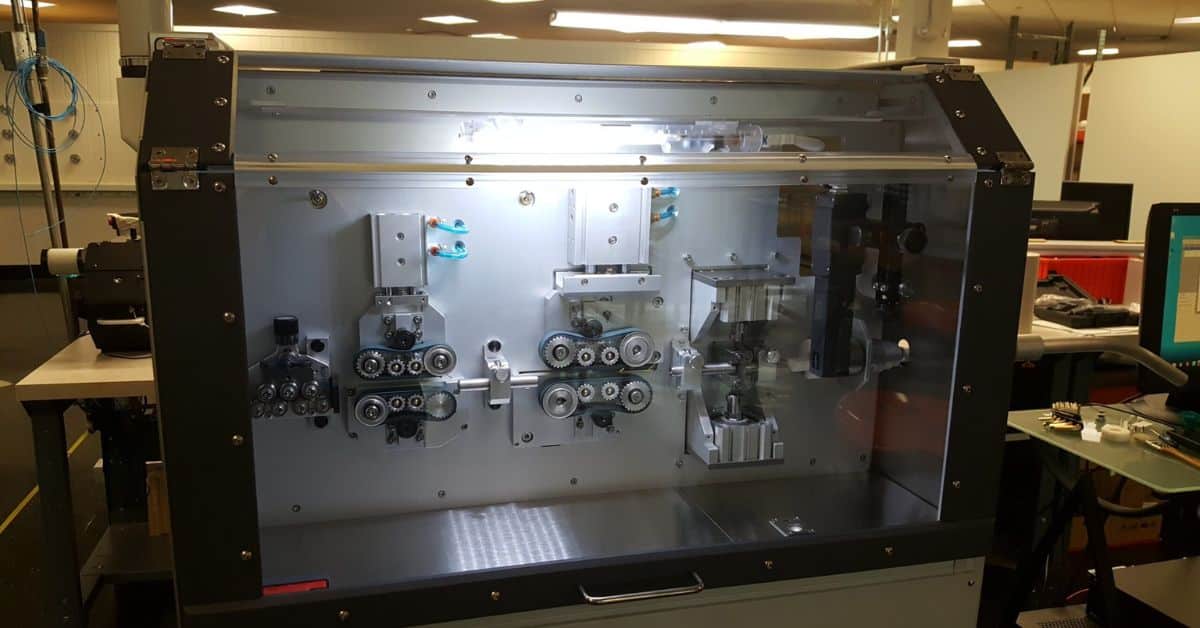
Wire identification represents a critical component in aerospace, defense, and industrial applications where performance failures can have catastrophic consequences. Engineers and technical teams require marking solutions that maintain legibility and durability under extreme conditions while meeting stringent regulatory standards.
UV laser marking technology is a superior method for achieving permanent, high-quality wire labeling that withstands the most demanding conditions. Keep reading to understand how laser wire marking works and its advantages over other methods for identification in harsh environments.
Traditional Wire Marking Methods Face Critical Limitations
For many industries and applications, hot stamping, dot matrix, and inkjet systems are the primary methods for wire marking. While these techniques have their uses, they fall short under intense conditions in industries like aerospace and defense.
Hot Stamping Technology
Hot stamping marks wires by pressing heated typefaces onto insulation via thermal transfer foils. This process requires precise control of temperature, pressure, and dwell time to avoid damaging insulation. However, the aerospace industry has raised concerns about its use, particularly for thin insulation materials. Boeing’s BAC 5152 specification limits hot stamping to cases where other marking methods fail to deliver acceptable results, citing risks to material integrity and long-term durability.
Hot stamping also faces operational challenges, including limited programmability, mechanical wear, and inconsistent mark quality across different insulation types. These drawbacks make it unsuitable for high-volume production environments that prioritize consistency and reliability.
Dot Matrix and Inkjet Systems
Other popular forms of wire marking include dot matrix and inkjet marking systems. Dot matrix and inkjet marking systems are popular for their non-contact printing and programmable message flexibility, eliminating the mechanical pressure issues of hot stamping. Inkjet systems use thermal or UV-cured inks to mark wire insulation, with Boeing BAC 5152 approving specific systems for marking wire types like BMS13 series, M22759 constructions, and M81044 specifications. UV-cured inks enable faster processes by skipping post-cure heating steps.
However, ink-based marking systems have limitations due to their surface application. Chemical exposure, mechanical abrasion, and long-term environmental degradation can remove ink marks over time, which raises concerns for applications that require permanent, tamper-proof identification.
UV Laser Marking Delivers Permanent, Non-Destructive Identification
Laser wire marking thrives as an identification method in harsh environments thanks to its advanced material interaction technology. These superior wire marking methods and systems are ideal solutions for industries like aerospace manufacturing.
Advanced Material Interaction Technology
UV laser marking works differently from surface-applied marking methods by interacting with titanium dioxide (TiO₂) pigments in wire insulation materials. These pigments, with an optical band gap of about 3.1 electron volts, strongly absorb UV radiation at wavelengths shorter than 380 nanometers. When UV laser energy interacts with the TiO₂ particles, a photochemical reaction occurs, permanently changing the pigments’ color from white or light to dark blue or black. This creates high-contrast marks that penetrate 10-20 micrometers below the surface without affecting the base polymer structure.
The nanosecond pulse duration of UV lasers prevents thermal diffusion of the surrounding materials, which limits the changes to the pigment particles themselves. This precise energy control safeguards the marking process and maintains the insulation’s electrical properties, mechanical strength, and resistance to environmental factors, making it an ideal solution for durable, non-invasive identification.
Aerospace Industry Applications
Major aerospace manufacturers like Boeing, Airbus, Lockheed Martin, and government agencies such as the Department of Defense, NASA, and the FAA have adopted UV laser marking for wire identification in both manufacturing and maintenance. Extensive testing of the technology’s durability in even the most extreme conditions backs the aerospace industry’s acceptance of laser marking.
UV laser marking meets MIL-W-5088L, AS-5088-L, and BAC5152 specifications, making it compliant with stringent aerospace standards. This eliminates the need for additional testing, making UV laser marking a reliable and efficient solution for high-performance applications in the aerospace sector.
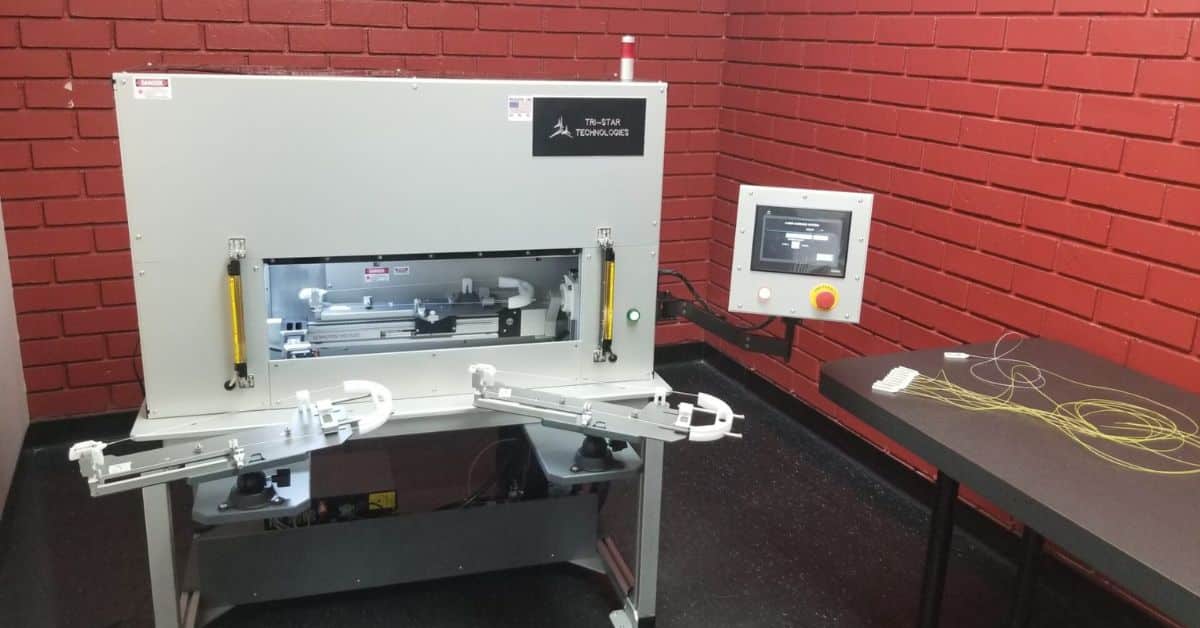
Tri-Star Technologies UV Laser Solutions
Tri-Star Technologies provides advanced UV laser marking systems for aerospace, industrial wire processing, and medical applications. The M100L series features 355nm solid-state UV lasers with high-speed scanning, achieving production rates of up to 100 feet per minute. For portable needs, the lightweight Econolase system supports alphanumeric, logo, and barcode marking, making it ideal for field installations and maintenance.
Special industrial laser marking machines include the M100L-FG-CT for catheter and medical tubing applications, offering automatic feeding and positioning, and the M100L-FG-TT-A tabletop system for processing wire sizes from 26 AWG to 4 AWG. This fully automated system includes precision measuring, pneumatic cutting, and motorized coiling, all backed by Class 1 laser safety certification and compliance with military and commercial standards.
Technical Excellence Through Material Science
The material science of Tri-Star Technologies’ laser wire marking systems makes them stand out from other marking methods and machines. The non-destructive chemical changes to the material guarantee a permanent marking, while its precision and quality assurance confirm a legible mark for years.
Optimized Pigment Interactions
UV laser marking effectiveness relies on the TiO₂ concentration in insulation materials, with optimal levels typically between two and four percent by weight. This range verifies high contrast marking without compromising material properties, as higher concentrations can cause brittleness, while lower levels result in poor contrast. Wire constructions using ETFE and XL-ETFE insulations with the correct TiO₂ levels, such as BMS 13-48 and M22759/32 series, demonstrate exceptional marking performance due to their optimized pigment distribution and material formulations.
PTFE tape-wrapped constructions, including BMS 13-58 and BMS 13-60 specifications, also achieve good marking contrast with the proper pigment levels. The multilayer tape structure creates distributed marking zones, enhancing durability and resistance to mechanical damage, making them reliable for long-term use.
Precision Control and Quality Assurance
UV laser systems offer precise control over energy density, pulse repetition rate, and beam positioning to deliver high-quality markings on various wire specifications. Advanced scanning systems allow for variable character sizing, multiple font options, and complex graphics reproduction while maintaining consistent quality at production speeds. Real-time monitoring confirms the consistent performance and mark quality, while automated quality control verifies legibility, contrast, and dimensional accuracy to meet strict aerospace standards.
The non-contact marking process eliminates mechanical wear and allows for unlimited message programmability. Systems automatically adjust marking parameters based on wire size, insulation type, and production speed, ensuring optimal results across a wide range of product specifications.
Proven Performance Across Industry Applications
Manufacturers in various industries utilize UV laser marking technology, including automotive, medical devices, and industrial markets for, permanent wire identification. Its tamper-evident marks are particularly valuable in security-sensitive applications. In the medical field, UV laser marking is an ideal solution for catheter identification, surgical instrument labeling, and pharmaceutical packaging, as it guarantees sterility while meeting regulatory traceability requirements.
In the automotive sector, UV laser marking is the highest standard for engine harness identification, sensor wire labeling, and electric vehicle battery systems. The technology’s durability against automotive fluids, temperature changes, and vibrations make it perfect for under-hood applications, where reliability is essential.
Future-Ready Wire Identification Solutions
UV laser marking is the leading technology for permanent wire identification, offering non-destructive marking, superior durability, and full regulatory compliance. Tri-Star Technologies continues to innovate UV laser systems, focusing on expanding material compatibility, improving processing speeds, and enhancing automation. These advancements ensure UV laser marking meets evolving industry needs. Contact Tri-Star Technologies to discover how it can optimize your wire processing operations.